What Are Dividends in Stocks A Comprehensive Guide for Beginner Investors
Finance
|
April 12, 2026
Welcome to the rewarding world of investing! If you’re just starting out, you may be wondering what dividends are in stocks. Understanding dividends is crucial for your financial journey as they can significantly enhance your investment strategy and increase your personal income. Dividends are essentially payments made by corporations to their shareholders, reflecting a fraction of their profits. For beginners, grasping this concept is vital—it not only helps you identify potential income sources within your stock portfolio but also guides you in selecting suitable investment opportunities.
Welcome to the rewarding world of investing! If you’re just starting out, you may be wondering what dividends are in stocks. Understanding dividends is crucial for your financial journey as they can significantly enhance your investment strategy and increase your personal income. Dividends are essentially payments made by corporations to their shareholders, reflecting a fraction of their profits. For beginners, grasping this concept is vital—it not only helps you identify potential income sources within your stock portfolio but also guides you in selecting suitable investment opportunities. As you embark on this journey, consider how dividends can serve as a reliable income stream, balancing the turbulence of stock prices with the promise of steady returns. Join us as we explore dividends: their definition, their importance, and how they can empower your financial independence!
What Are Dividends in Stocks?
Understanding Dividends
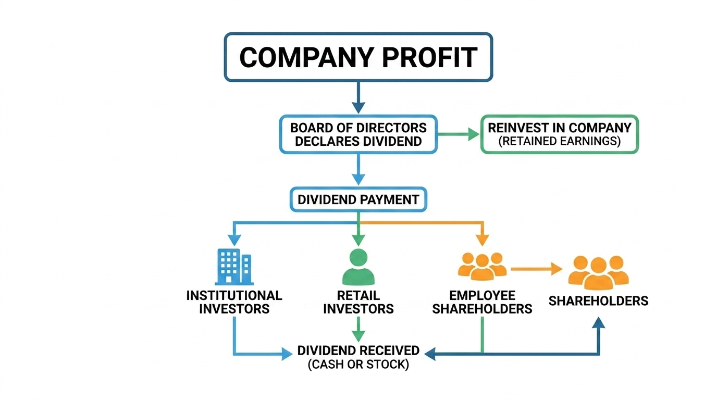
Dividends, in simple terms, are payments made by corporations to their shareholders, usually taken from the company’s profits. When you purchase shares of stock, you are essentially buying a small portion of that company. If the company performs well, it can decide to share a portion of its earnings with shareholders in the form of dividends. For instance, if Company A declares a dividend of $1 per share, an investor holding 100 shares would receive $100. Dividends can come in various forms, including cash payments directly deposited into an investor's account or additional shares of stock offered as a dividend reinvestment option. Participating in dividends enables investors to earn a return on their investment even if stock prices remain stable or experience limited appreciation.
How Companies Pay Dividends
Companies typically distribute dividends on a regular basis, often quarterly, although some may choose annual or semi-annual distributions. The process begins when a company's board of directors declares a dividend. This announcement includes vital information such as the dividend amount, the ex-dividend date (the cutoff date by which investors must own shares to be eligible for the dividend), and the payment date. Investors who own shares before the ex-dividend date are eligible to receive the next dividend payout. On the payment date, the company distributes the declared funds to the eligible shareholders. This structured process promotes fairness and transparency in dividend distributions to all qualified investors while aligning with the company’s financial performance.
Why Companies Distribute Dividends
Companies opt to distribute dividends for various reasons, often tied to strong financial performance and strategic business decisions. Firstly, paying dividends can attract investors who seek regular income, helping to stabilize the stock price and draw in long-term investors. Secondly, a consistent dividend payment typically signals to the market that a company is financially healthy and confident in its sustainable profitability. Well-established firms like Coca-Cola and Johnson & Johnson are notable for their regular dividend payments, illustrating their commitment to rewarding shareholders. However, it’s worth noting that some companies may choose to retain earnings to reinvest in business growth to drive development, and hence not all firms provide dividends. Consequently, deciding to pay dividends represents a balancing act that reflects a company's financial approach and market strategy.
How Do Stock Dividends Work?
Dividend Declaration Process
The dividend declaration process begins with a company’s board of directors deciding to allocate a portion of its earnings to shareholders. This is formally announced as a specific amount per share, referred to as the dividend rate. For example, if a company declares a dividend of $1 per share and you own 100 shares, you will receive $100 in dividends. After declaring the dividend, the company will provide the record date, which identifies the last date when shareholders must own the shares to qualify for the dividend. This transparent declaration aids investors in understanding the company's financial health and dedication to returning value to shareholders.
Ex-Dividend Date and Its Importance
The ex-dividend date plays a critical role for investors, marking the cutoff date for receiving the upcoming dividend. Purchasing the stock on or after this date means you will not receive the declared dividend; only shareholders who owned the stock before this date will receive the payout. For example, if a stock's ex-dividend date is April 15 and you buy it on April 16, you will not receive the dividend payment for that period. This date is typically one business day before the record date and is crucial for investors to plan their purchases accordingly, ensuring dividend eligibility.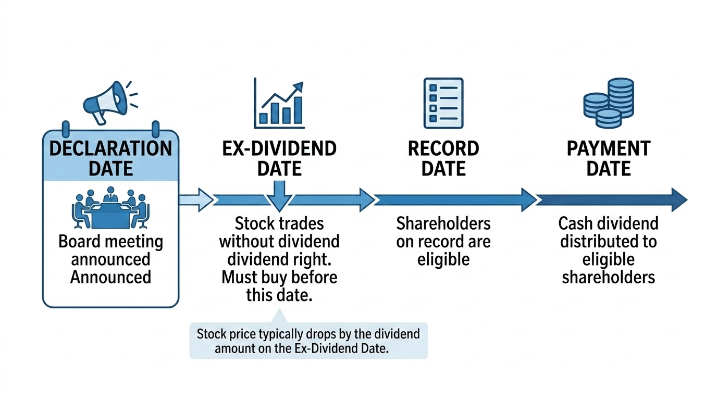
Payment Distribution Mechanics
Once the ex-dividend date has passed, approved dividend payments are generally distributed on the payment date, which follows the record date. Companies can issue dividends through checks or direct deposits into investors’ brokerage accounts. For instance, if the payment date for a $1 dividend is set for May 1, and the company has numerous shareholders, they may opt to use direct deposits for efficiency. This streamlined distribution mechanism enables investors to receive their returns quickly, enhancing their overall investment experience and providing tangible benefits for their holdings in the company.
Types of Dividends in Stocks
Cash Dividends
Cash dividends represent direct payments by a company to its shareholders, typically in cash form. This type of dividend provides immediate income for investors and is often paid quarterly. For example, if Company A declares a cash dividend of $1 per share, and you possess 100 shares, you would receive $100. Cash dividends are particularly appealing to income-focused investors who prioritize regular returns from their investments. They not only reflect a company’s profitability but also its willingness to share profits, making them a fundamental aspect of many investment strategies.
Stock Dividends
Stock dividends occur when a company issues additional shares to its shareholders instead of cash. This type of dividend increases the number of shares an investor holds but typically does not change the overall investment value since the share price adjusts accordingly. For instance, if Company B declares a 10% stock dividend, and you own 100 shares, you would receive 10 additional shares, totaling 110 shares after the dividend. Such stock dividends may attract growth-oriented investors as they demonstrate the company’s ability to reinvest in its business while rewarding shareholders with increased equity.
Special Dividends
Special dividends are unique, one-time payments made by a company, usually resulting from exceptional profits or surplus cash. Unlike regular cash dividends, special dividends are not expected to recur consistently, making them an intriguing opportunity for investors. For instance, if Company C experiences an unexpectedly lucrative year and provides a special dividend of $2 per share, a shareholder with 50 shares would receive $100. Special dividends indicate that the company is financially sound and willing to share extraordinary profits, making them attractive for those seeking a boost in their investment returns without altering their long-term equity stakes.
Why Companies Pay Dividends
Profit-Sharing Mechanics
Dividends serve as a mechanism for companies to share profits with their shareholders, distributing a portion of their earnings directly to investors. This practice not only rewards shareholder loyalty but also denotes the overall health of the business. When a company generates profits that exceed its reinvestment needs for growth, it may allocate excess earnings for dividends. A well-established corporation sustaining stable cash flows may choose consistent dividend payouts to nurture investor trust. Thus, dividends act as a tangible return on investment, incentivizing shareholders who favor immediate benefits over potential future capital gains. This strategic approach strengthens the relationship between the company and its investors, enhancing confidence in the company's commitment to sharing its success.
Attracting Investors
Dividends are an attractive aspect for both institutional and retail investors, providing a reliable income stream alongside potential capital growth. Companies that consistently pay dividends can attract income-focused investors, such as retirees or those with a conservative risk profile who seek lower-risk investment horizons. By showcasing strong dividend yields, companies can position themselves as financially stable and less volatile, drawing in a wider range of investors. For example, in market downturns, dividend-paying stocks often exhibit reduced price volatility in comparison to stocks that do not offer dividends, since the income generated acts as a buffer against declining stock prices. This capability to capture investor interest is not only beneficial for marketability but is also integral to a company’s long-term objective of maintaining a robust shareholder base.
Dividends as a Signal of Stability
Dividends symbolize a company’s resolve to maintain financial health and stability. When a company consistently provides dividends, it communicates to the market that it is generating ample earnings to support these distributions and remains confident in its future cash flows. Often, companies will increase their dividends as a demonstration of growth and to reassure investors during uncertain economic climates. Conversely, a sudden reduction in dividends can prompt negative perceptions regarding the company’s health. Many investors regard Dividend Aristocrats—companies with a track record of raising dividends annually—as more stable and dependable investment choices. Through the continuous return of capital to shareholders, dividends foster a sense of security and trust while reinforcing the belief in the company’s ongoing viability and performance.
Benefits and Risks of Dividend Investing
The Potential for Passive Income
Dividend investing presents a robust strategy for generating passive income, empowering investors to earn money without the need for active investment management. With regular dividend payouts, which typically occur quarterly, investors enjoy a consistent income flow, even amid fluctuating stock prices. This consistency is especially appealing for retirees or individuals seeking supplementary income. For instance, if an investor holds shares in a company that pays a $1 annual dividend per share, owning 100 shares results in $100 annually—providing reliable cash flow. Moreover, reinvesting dividends can facilitate compound growth over time, significantly enhancing overall returns on investment. Therefore, dividends not only deliver immediate income but also provide a pathway for wealth accumulation, making them a preferred option among income-driven investors.
Portfolio Stability
Investing in dividend-paying stocks can significantly contribute to portfolio stability, particularly during turbulent market conditions. Companies that maintain consistent dividend payments are often well-established with solid fundamentals, which can serve as indicators of financial health and resilience. The stability offered by dividends becomes crucial during economic downturns, as they can cushion market fluctuations and reduce the impact of declining share prices. For example, in a bear market scenario, while growth stocks may see drastic declines, dividend stocks often retain their value better by continuing to deliver income despite price drops. Thus, including dividend-paying stocks in your investment portfolio can augment overall stability and promote long-term success for risk-averse investors.
Risks of Dividend Investing
Dividend Cuts
An inherent risk associated with dividend investing is the potential for dividend cuts, wherein a company reduces or completely eliminates its dividend payout. Such cuts may arise from a variety of factors, including poor financial performance, strategic business shifts, or economic downturns. When a dividend is cut, it not only diminishes expected income but may also adversely impact the stock price, leading to capital losses for investors. Therefore, it is imperative to assess a company's financial stability and historical performance before investing to minimize this risk.
Market Volatility
Dividend stocks are not immune to market volatility, which can significantly influence their stock prices. Even well-established companies known for paying dividends can experience price fluctuations driven by broader market conditions or shifts in investor sentiment. During economic uncertainty, even reliable dividend payers may encounter price declines that negatively affect investor portfolios. Although dividends can mitigate some of this volatility, the underlying stock prices still pose a risk to investor capital.
Overconcentration Risk
Overconcentration risk occurs when an investor’s portfolio has an excessive amount of capital in dividend-paying stocks or specific sectors renowned for high dividends, such as utilities or consumer staples. While emphasizing dividend stocks can yield benefits, it also renders investors susceptible to sector-specific downturns. For instance, if the utility sector faces regulatory or economic challenges, investors heavily concentrated in this area could endure significant losses. To diminish overconcentration risk, dividend investors should diversify their holdings across various industries and asset classes, successfully balancing income generation with risk management strategies.
Real-Life Examples of Dividend Investing
Retired Investor's Income Strategy
Consider Tom, a retired engineer who began investing in dividend-paying stocks a decade before retiring. Over time, he developed a diversified portfolio, reaping a steady income largely sourced from quarterly dividends. Rather than relying solely on savings, Tom enjoys regular payments from trustworthy companies, which help him manage living expenses and indulge in occasional vacations. By reinvesting dividends during the early years, he amplified his income stream, creating a financial cushion for his retirement. Tom’s investment strategy exemplifies how dividend investing facilitates comfortable living while maintaining financial independence, underscoring the significance of dividends as a dependable income source.
Long-Term Wealth Building Through Dividends
Consider Lisa, who began her journey in dividend stocks at age 25. Initially navigating an unclear investment landscape, she committed to selecting established companies known for consistent dividends. By maintaining her holdings and reinvesting dividends, her portfolio has witnessed exponential growth over the years. Two decades later, Lisa’s investments not only generate substantial income but have also appreciated significantly, empowering her to leverage accumulated wealth for future aspirations, such as purchasing a home or securing her children’s education. Her story illustrates that patience and discipline in dividend investing can considerably enhance long-term wealth, ensuring financial security for the future.
Beginner-Friendly Dividend Portfolio Concept
For novices like Sarah, creating a beginner-friendly dividend portfolio can start with a selection of well-established companies recognized for reliable dividends. Sarah may opt to invest in a mix of blue-chip stocks across diverse sectors, such as technology, consumer goods, and healthcare. For instance, she might consider adding a tech giant like Apple, a consumer staple like Procter & Gamble, and a healthcare leader such as Johnson & Johnson to her portfolio. By focusing on companies with a proven history of consistent dividend payments, Sarah establishes a balanced portfolio that can provide steady income while reducing risk. This strategy not only eases her entry into investing but also bolsters her confidence as she continues to develop her financial knowledge and investment approach.
Was this helpful? Share your thoughts