

Why You’re Still Tired After Sleeping Enough
While you are sleeping, a myriad of processes takes place throughout your body. During this time, you transition between REM sleep, which stands for rapid eye movement, and non-REM sleep. In the REM phase, your eyes exhibit vigorous movement in various directions, and your brain is nearly as active as when you are wide awake, which is when most dreaming occurs. Conversely, the non-REM sleep phase involves less brain activity, and as you progress into the deeper stages, you experience slower breathing and a reduction in blood pressure. Typically, when you fall asleep, you first enter non-REM sleep, proceed to REM sleep for a briefer period, and then the cycle begins anew.
REM Sleep vs. Non-REM Sleep
While you are sleeping, a myriad of processes takes place throughout your body. During this time, you transition between REM sleep, which stands for rapid eye movement, and non-REM sleep. In the REM phase, your eyes exhibit vigorous movement in various directions, and your brain is nearly as active as when you are wide awake, which is when most dreaming occurs. Conversely, the non-REM sleep phase involves less brain activity, and as you progress into the deeper stages, you experience slower breathing and a reduction in blood pressure. Typically, when you fall asleep, you first enter non-REM sleep, proceed to REM sleep for a briefer period, and then the cycle begins anew.
Stages of Sleep
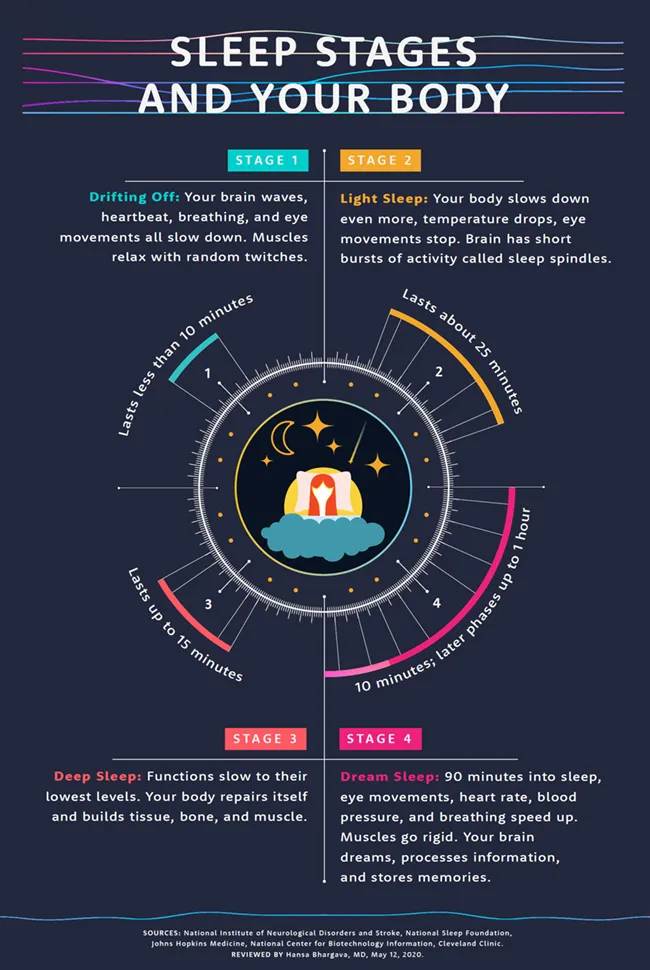
Throughout the night, your sleep is composed of cycles that range from 90 to 120 minutes each. These cycles consist of three non-REM (NREM) stages followed by a REM sleep stage. The three NREM stages are traversed before entering REM sleep:
Stage 1: During this stage, although your eyes are closed, you are still quite easily awakened. This phase is short-lived, lasting about 5 to 10 minutes.
Stage 2: In this phase, you enter a light sleep that is deeper than Stage 1. There’s a noticeable slowing of your heart rate and breathing, while your body temperature decreases as your body prepares for deep sleep, which lasts from 10 to 25 minutes.
Stage 3: This deep sleep stage makes awakening particularly challenging, and disruptions during this stage often leave you feeling disoriented. In adults, this stage accounts for approximately 25% of total sleep time. Deep stage NREM sleep is vital as it's a period when your body repairs and regenerates tissue, builds bone and muscle, and bolsters the immune system.
As you age, sleep tends to become lighter with less time spent in deep stages. Aging is often linked with shorter sleep spans, although it is found that the requirement for sleep remains unchanged from when you were younger. After NREM, you typically transition into the REM stage, and following REM, a new cycle begins. With 8 hours of sleep per night, one typically experiences four to five cycles.
What Is REM Sleep?
REM sleep generally commences about 90 minutes after you initially fall asleep. The first REM cycle typically lasts for about 10 minutes, and each successive REM phase gradually extends with the final one lasting nearly an hour. During this stage, heart rates and breathing rates increase. Generally, muscles become relaxed to prevent acting out dreams. REM sleep is where you might have the most vivid dream experiences due to increased brain activity.
REM sleep is crucial as it stimulates brain areas involved with learning and memory retention. It aids in the processing of emotional experiences and facilitates the transition of short-term memories into long-term storage.
Symptoms of REM Sleep Deprivation
Failure to secure enough REM sleep can manifest through symptoms such as:
Struggles with emotional regulation.
Difficulty in focusing or concentrating.
A weakened immunity.
Morning grogginess.
Enhancing your REM sleep could alleviate these symptoms.
Enhancing REM Sleep
Augmenting REM sleep requires increasing your overall sleep time. Some strategies to improve your sleep quality include:
Creating a calm bedtime routine to ease into sleep.
Maintaining a steady sleep schedule by going to bed and waking up at the same time daily.
Steering clear of nicotine and caffeine.
Incorporating daily exercise and spending some time outside in natural daylight.
Avoiding alcohol and large meals close to bedtime.
Steering clear of screens before bed because the emitted light can impede sleep.
Experiencing Excessive REM Sleep
Occasionally, you might engage in more extended periods of REM sleep than usual. More frequent and deeper REM cycles can reflect a phenomenon called REM rebound, which might occur if you have been sleep-deprived, typically sleeping less than 7 hours nightly, or if under stress or undergoing drug withdrawal. REM rebound serves to recalibrate the sleep cycle. Signs include:
Intense and vivid dreams or nightmares.
Disorientation upon waking.
Headaches.
Improving general sleep will usually moderate REM rebound.
How Much Deep Sleep Is Necessary?
The time spent in various sleep stages fluctuates from night to night and can change over a lifetime. For instance, infants spend half their sleep time in the REM stage, whereas adults only allocate about 20% to REM. Stage 3 of NREM sleep marks the deep sleep phase, predominantly experienced during youth but gradually reducing with age. Typically, adults spend about 25% of their sleep in Stage 3, but this proportion decreases with aging. Sleep need varies by age:
Babies up to 12 months need 12-17 hours (including naps).
Children up to 5 years old require 10-14 hours (including naps).
Children aged 6-12 need 9-12 hours.
Teenagers require 8-10 hours.
Adults need 7-9 hours.
For an adult sleeping 8 hours a night, roughly 2 hours would fall into the deep sleep category.
Takeaways
Each slumber initiates a new sleep cycle traversing through non-REM to REM stages. Dreams typically occur during REM, while the deepest rest happens in non-REM sleep stages. Both REM and non-REM sleeps are vital as they facilitate brain and body maintenance and memory processing during sleep. Inadequate sleep could negatively impact your physical and emotional health, as well as overall well-being.
REM FAQs
Which is better, REM or non-REM sleep?
Both REM and non-REM sleep are essential. REM assists with learning and memory, while non-REM focuses on physical restoration and tissue regeneration.
What is the main difference between NREM and REM sleep?
In REM sleep, one observes rapid eye movements and significant brain activity, while deeper rest and lowered heart rate occur during NREM.
Is REM sleep beneficial?
Yes, REM sleep plays a crucial role in improving learning, memory, concentration, and mood regulation.
What benefits does non-REM sleep provide?
Non-REM sleep aids in tissue repair and growth, bone and muscle development, and in fortifying the immune system.
What does the REM sleep cycle entail?
Nightly, you undergo several sleep cycles, each incorporating a REM stage and three non-REM stages. An 8-hour sleep typically encompasses four to five such cycles.

Toyota Prado 2025 — Rugged Strength Meets Modern Innovation

2026 Toyota RAV4: Where Innovation Meets Everyday Adventure

2025 Honda CR-V EX: Crafted for Comfort, Built for Performance

Emergency Plumbing Services: 24-Hour Solutions for Urgent Home Disasters

Safeguard Your Business with Modern Network Security Solutions
